

Types of Cancer
Cancer Classification by tissue type of origin
Carcinoma | Sarcoma | Myeloma | Leukemia | Lymphoma
Carcinoma
Carcinoma is a type of cancer that originates in epithelial cells, which line most of our organs, internal passageways in our body and the skin. It is the most common type of cancer, accounting for 80-90% of cancer cases in humans. Carcinomas can arise in various tissues, and their behavior, prognosis, and treatment options depend on the specific subtype, location, and molecular characteristics.
Subtypes:
- Adenocarcinoma: From glandular epithelial cells, that secrete mucus or other substances.
- Basal Cell Carcinoma (BCC): From basal epidermal cells, the top layer of the skin.
- Squamous Cell Carcinoma (SCC): From squamous epithelial cells, that form the surface of the skin, respiratory and digestive organs.
- Ductal carcinoma in situ (DCIS): From the breast milk ducts, that hasn’t spread.
- Invasive ductal carcinoma: From the breast milk ducts, that has spread to nearby tissue.
Sarcoma
Sarcoma refers to cancer that arises from connective or supportive tissues, including bone, cartilage, fat, muscle, and blood vessels. Unlike carcinomas, sarcomas are rare and make up only 1% of all adult cancer diagnoses and about 15% of childhood cancer.
Common subtypes:
- Osteosarcoma or osteogenic sarcoma: Bone
- Chondrosarcoma: Cartilage
- Leiomyosarcoma: Smooth muscle
- Rhabdomyosarcoma: Skeletal muscle
- Mesothelial sarcoma or mesothelioma: Membranous lining of body cavities
- Fibrosarcoma: Fibrous tissue
- Angiosarcoma or hemangioendothelioma: Blood vessels
- Liposarcoma: Adipose tissue
- Glioma or astrocytoma: Neurogenic connective tissue found in the brain
- Myxosarcoma: Primitive embryonic connective tissue
- Mesenchymous or mixed mesodermal tumor: Mixed connective tissue types
Myeloma
Cancer that originates in plasma cells, a type of white blood cells found in the bone marrow. While healthy plasma cells produce antibodies, that help fght infections, abnormal plasma cells multiply and producte abnormal antibodies, that harm the body. Myeloma accounts for 1% of all cancers, but 10% of all blood cancers diagnosed, with the average age of diagnosis being 65-70.
Leukemia
Leukemia is a cancer of the bone marrow, where blood cell production occurs. It results in the overproduction of abnormal, immature white blood cells known as leukemia cells. These leukemia cells outcompete normal blood cells in the bone marrow, leading to a significant reduction in healthy white blood cells, red blood cells, and platelets. Consequently, individuals with leukemia face an increased risk of infections, reduced oxygen delivery to tissues, and impaired wound healing. Leukemia accounts for about 3% of all cancers.
Classification by speed:
- Acute Leukemia: Disease progresses quickly.
- Chronic Leukemia: Some leukemia cells retain limited function, while others are completely non-functional, contributing to a slower disease progression. Symptoms may not appear for several years.
Classification by cell type:
- Lymphocytic Leukemia: Develops from lymphoid cells, which are precursors to white blood cells.
- Myeloid Leukemia: Develops from myeloid cells, which are precursors to red and white blood cells, as well as platelets.
Main Types:
- Acute Lymphocytic Leukemia (ALL): Most common in children, teens and young adults.
- Acute Myeloid Leukemia (AML): Occurs in all age groups.
- Chronic Lymphocytic Leukemia (CLL): Common in older adults.
- Chronic Myeloid Leukemia (CML): Common in older adults.
Lymphoma
Cancer of the lymphatic system, which includes the lymph nodes, spleen, thymus, and lymphatic vessels. Lymphoma originates from lymphocytes, a type of white blood cell responsible for helping the body fight infections. Lymphoma accounts for about 4% in all age groups, but occurs the most often in early adulthood (age 20-29) and late adulthood (age 55+).
Main Types:
- Hodgkin Lymphoma (HL): Characterized by the presence of abnormal white blood cells, also called Reed-Sternberg cells.
- Non-Hodgkin Lymphoma (NHL): A diverse group of cancers that do not have Reed-Sternberg cells.
Cancer Classification by Location
(including links to futher information)
Head and Neck | Digestive System | Urinary System | Lung | Breast | Reproductive System | Endocrine System | Skin | Bone and Soft Tissue | Eye | Brain and Nervous System | Blood and Lymph System | Others
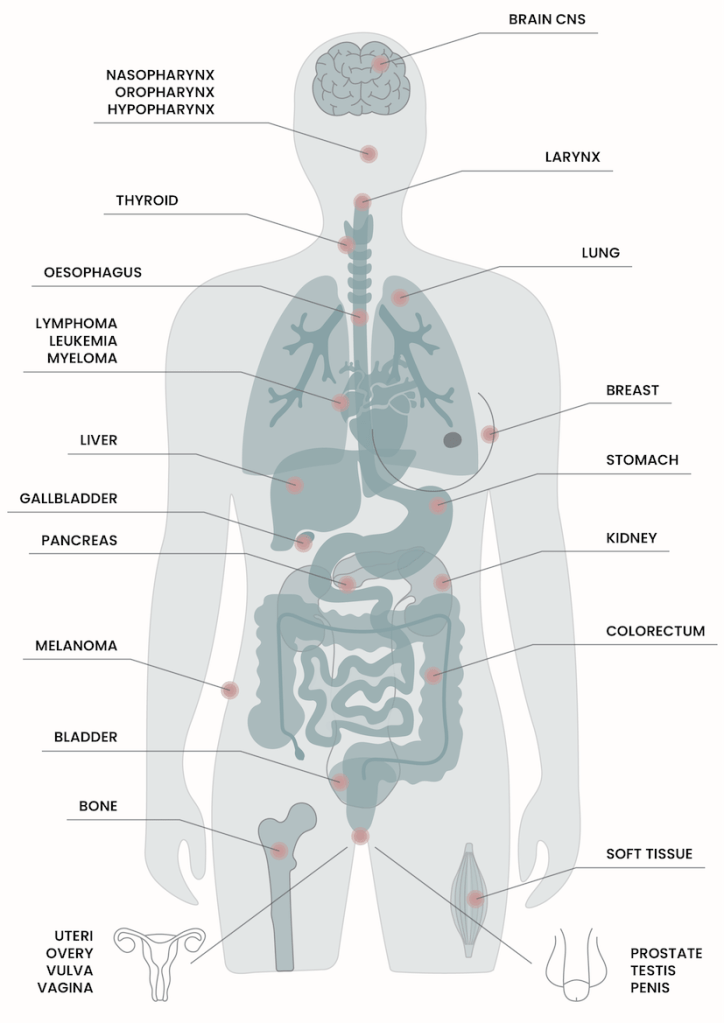
Head and Neck
- Head and Neck Cancers
- Laryngeal and Hypopharyngeal Cancer
- Nasal Cavity and Paranasal Sinuses Cancer
- Nasopharyngeal Cancer
- Oral Cavity (Mouth) and Oropharyngeal (Throat) Cancer
- Salivary Gland Cancer
Digestive System
- Anal Cancer
- Bile Duct Cancer
- Colorectal Cancer
- Esophagus Cancer
- Gallbladder Cancer
- Gastrointestinal Neuroendocrine (Carcinoid) Tumors
- Gastrointestinal Stromal Tumor (GIST)
- Liver Cancer
- Pancreatic Cancer
- Pancreatic Neuroendocrine Tumor (NET)
- Small Intestine Cancer
- Stomach Cancer
Urinary System
Lung
Breast
Reproductive System
- Cervical Cancer
- Endometrial Cancer
- Ovarian Cancer
- Penile Cancer
- Prostate Cancer
- Testicular Cancer
- Uterine Sarcoma
- Vaginal Cancer
- Vulvar Cancer
Endocrine System
- Adrenal Cancer
- Gastrointestinal Neuroendocrine (Carcinoid) Tumors
- Lung Carcinoid Tumor
- Pancreatic Neuroendocrine Tumor (NET)
- Pituitary Tumors
- Thyroid Cancer
Skin
- Skin Cancer
- Basal and Squamous Cell Skin Cancer
- Kaposi Sarcoma
- Lymphoma of the Skin
- Melanoma Skin Cancer
- Merkel Cell Skin Cancer
Bone and Soft Tissue
EyE
Brain and Nervous System
Blood and Lymph System
- Leukemia
- Acute Lymphocytic Leukemia (ALL) in Adults
- Acute Myeloid Leukemia (AML) in Adults
- Chronic Lymphocytic Leukemia (CLL)
- Chronic Myeloid Leukemia (CML)
- Chronic Myelomonocytic Leukemia (CMML)
- Leukemia in Children
- Lymphoma
- Non-Hodgkin Lymphoma
- Non-Hodgkin Lymphoma in Children
- Hodgkin Lymphoma
- Multiple Myeloma
- Myelodysplastic Syndromes
- Thymus Cancer
- Waldenstrom Macroglobulinemia
Others
Reviewed. 01/2025
 Within Oncology